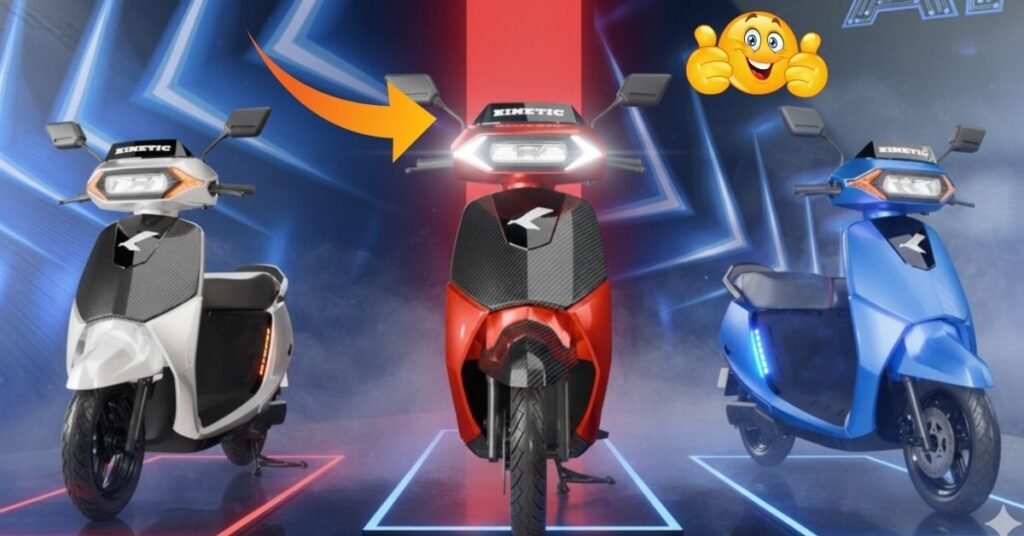
Kinetic DX Electric Scooter: If you’re in the market for an electric scooter that blends a bit of nostalgia with modern tech and practicality, the Kinetic DX electric scooter stands out. In this airtical I’ll walk you through what makes it special in 2025: its design and heritage, performance and range, features and technology, pricing and market positioning — and help you figure out whether it could be the right ride for you.
Design & Heritage: A Modern Scooter with Retro Roots
The Kinetic DX takes inspiration from the legendary two-stroke scooter that many Indian riders remember, and re-imagines it for the electric era. Its body still carries cues of the original silhouette — especially the flat floorboard, the metal body feel and the bold branding — but the parts under that skin are thoroughly updated.
Visually, you’ll notice clean lines, 12-inch alloy wheels, tubeless tyres, a big LED headlamp surrounded by LED DRLs, and a visor bearing the Kinetic logo. The overall impression is one of personal style and urban practicality, rather than high-end sport bike aggression. It feels approachable.
The build includes a ground clearance of about 165 mm and a wheelbase of 1,314 mm, which adds to the stability and comfort especially on Indian city roads. Under-seat storage is generous — about 37 litres — enough for a full-face helmet or daily essentials, which means the scooter works well for everyday commuting.
So the design message here is clear: nostalgic design + modern EV sensibility, tailored for the urban Indian rider.

Performance & Range: Practical Power for Daily Use
Kinetic DX Electric Scooter: Performance-wise the Kinetic DX packs a hub-mounted electric motor of 4.8 kW (approx) fed by a 2.6 kWh LFP (Lithium Iron Phosphate) battery pack. The standard DX variant claims a range of around 102 km on a full charge and a top speed of 80 km/h; the DX+ ups the ante to around 116 km range and a top speed of about 90 km/h under ideal conditions.
It’s worth noting that in real-world riding (city stop-start, inclines, heavier loads), the effective range may be less — but for most urban use this is quite competitive in its segment. Also, the battery life cycle is claimed to be better than typical NMC packs used elsewhere: the LFP battery is touted to offer 2,500 to 3,500+ cycles.
Charging time isn’t always detailed clearly in every report, but given the battery size and technology you can expect practical full-charging in standard home-power conditions. The scooter also benefits from regenerative braking and modern electronics which help maximise efficiency.
In short: you won’t be getting super-bike speeds, but for commute-and-city use the Kinetic DX offers a compelling balance of performance, range and usability.
Features & Technology: Smart Conveniences for the Everyday
What differentiates a good commuter EV from a basic one is the feature set — and the Kinetic DX delivers some useful modern touches. The instrument cluster is an 8.8-inch digital display in some specs, supporting ride-modes (Range, Power, Turbo) and providing good connectivity.

Connectivity features go further in the higher spec DX+ variant: Mobile app control, geo-fencing, vehicle tracking, voice alerts, and built-in speaker features for music/voice nav are part of the package. The scooter comes with a metal body, flat floorboard, keyless start, a one-touch retractable charger cable (“Easy Charge”), pillion footrest flip, and a spacious under-seat storage compartment.
On safety and ride comfort: Telescopic front fork, twin rear shock absorbers, 220 mm front disc brake, 130 mm rear drum with combined braking system (CBS) – these specs clearly show the manufacturer has given serious thought to ride quality as well as safety.
So if you value convenience and modern tech alongside EV efficiency, the Kinetic DX checks many boxes.
Pricing, Availability & Market Positioning in India
When it comes to cost, the Kinetic DX is priced starting at around ₹1,11,499 (ex-showroom, India) for the standard variant and around ₹1,17,499 for the DX+ variant. These prices place it in the slightly premium end of commuter EV scooters, but still well below ultra-premium two-wheelers.
How does it compare to rivals? It competes with models like the Bajaj Chetak 3001, TVS iQube and the Ather Rizta. The strategy appears to be targeting commuters who want build quality, brand heritage, style and decent EV range, without moving into extremely high price territory.

One caveat: Service and support infrastructure may matter when you buy an EV — brand coverage, battery support, spare parts availability and so on. So it’s worth checking your local dealer’s support for Kinetic EVs.
Read more : POCO X5 Neo 5G
Should You Consider Buying the Kinetic DX?
Yes — if you’re looking for an electric scooter that stands out from the crowd, has heritage, usable features, decent range and good build quality, the Kinetic DX is very much worth a look.
However, keep in mind: if your daily ride is extremely long (100+ km each way) or you’re using it for heavy loads or off-road, then you might want to check the real-world range, or compare with higher-range rivals. Also, make sure the dealer support and warranty (especially for the battery) is solid.
If I were to summarise: The Kinetic DX brings style, technology and practicality together in a package that suits modern Indian urban mobility — for riders who value more than just the lowest cost.
Final Thoughts
In this airtical, we’ve covered how the Kinetic DX electric scooter blends nostalgia with up-to-date EV tech, offers competitive performance and features in 2025, and positions itself as a smart, stylish commuter choice for city riders. If you’re ready to go electric, the DX is more than just another scooter — it’s a statement of style, convenience and forward thinking.