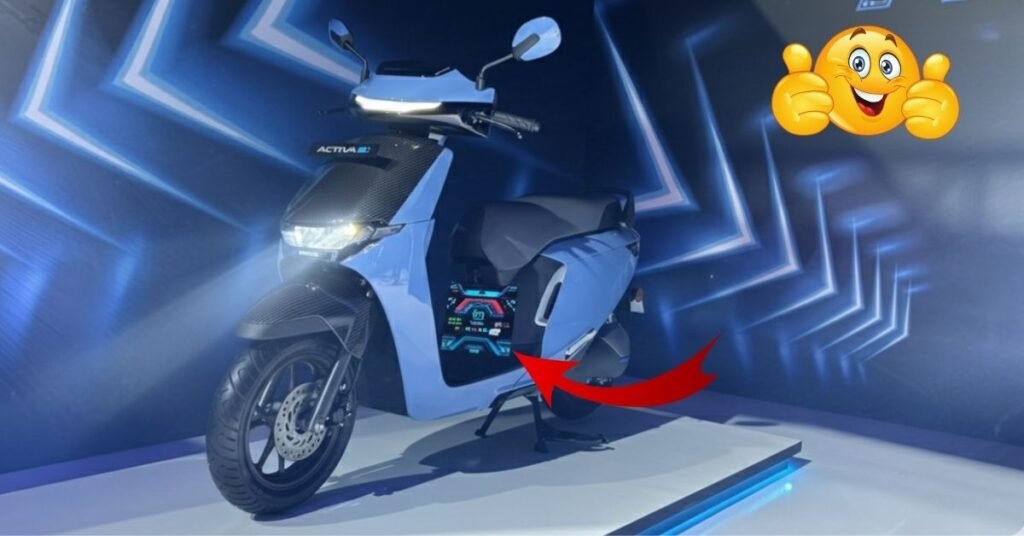
Honda Activa Electric: The moment has arrived for one of India’s most beloved scooter names to step into the electric era. The new Honda Activa e: (often called “Honda Activa Electric”) marks a major move by Honda into the electric two-wheeler space, and if you’re thinking about an everyday commuter that balances familiarity with future tech, this model deserves a close look.
Design and Everyday Usability
When you first glance at the Honda Activa Electric, it carries the recognizable form of the traditional Activa family—clean lines, compact footprint, and that approachable scooter stance so many Indian owners are comfortable with. However, Honda has subtly adapted the design for the EV era: the front apron features a pronounced LED headlamp with a distinctive daytime running light signature, and the bodywork has been optimised to accommodate the electric underpinnings while keeping a familiar silhouette.
Inside, the shift to electric means you’re greeted with a more digital instrument cluster and a few modern touches. For example, Honda has incorporated its “H-Smart” key features (including Smart Unlock, Smart Start and a Smart Safe mode) into the Activa Electric, giving the scooter a level of convenience that goes beyond ‘just a petrol scooter repackaged as EV’.
That said, there are trade-offs. Because Honda has gone with swappable batteries rather than one fixed pack, under-seat storage space is extremely limited—users have noted this as a significant omission compared to other e-scooters in the market.
Read more : Suzuki Burgman Street 2025
Powertrain, Range & Performance
Honda Activa Electric: Underneath the friendly exterior lies a fairly modern electric drivetrain. The Honda Activa Electric is propelled by a wheel-side permanent-magnet synchronous motor rated at 6 kW (with a continuous rating around 4.2 kW) and producing approximately 22 Nm of torque. Honda quotes a top speed of 80 km/h and a 0-60 km/h sprint in around 7.3 seconds—figures that place it firmly in commuter-territory rather than outright performance.

One of its distinguishing features is the battery architecture: the scooter uses two swappable lithium-ion “Honda Mobile Power Pack e:” battery packs, each rated at 1.5 kWh, giving a combined total of 3 kWh in the standard variant. Honda claims a range of 102 km under IDC (Indian Driving Cycle) conditions.
The swappable-battery model is meant to ease one of the key anxieties around EVs: range and charging time. Honda also plans battery-swap infrastructure (under its “e:Swap” service) in select Indian cities including Bengaluru, Delhi NCR and Mumbai.
In short, for many daily urban users—commuters, short-distance riders—the Activa Electric offers more than enough performance and range to cover their regular usage. The standard ride mode gives balanced efficiency, while a “Sport” mode is available for slightly quicker throttle response (though the top speed remains the same).
Pricing, Availability & Market Context
In terms of pricing, the pre-launch reports suggest an ex-showroom tag starting around Rs 1.17 lakh (base variant) and going up to ~Rs 1.52 lakh for higher variants in India. While this positions the Activa Electric in a premium bracket compared with some budget EV scooters, for a brand as trusted as Honda with widespread service network and the Honda Activa Electric, many buyers may consider this premium justified.
Availability has been phased: Honda Activa Electric has indicated that initial rollout would begin in major cities like Delhi NCR, Bengaluru and Mumbai, with bookings opening in early 2025 and deliveries planned soon thereafter.
It’s important to note that in the Indian EV two-wheeler market, switching to electric means evaluating new parameters: battery infrastructure, after-sales, and real-world usability just as much as sticker price. On those fronts, Honda’s move with the Activa Electric is a welcome step, but not without its caveats.

What Works & What Might Give You Pause
One of the biggest advantages of the Honda Activa Electric is its brand strength and familiarity. Many riders already trust the Activa name; it’s comfortable, widely understood, and has widespread service reach. The introduction of electric under the same badge gives peace of mind. Performance is practical—80 km/h top speed and a 102 km range are more than sufficient for city commuting and even occasional short bursts outside urban centres. The swappable battery approach also gives flexibility, especially where home charging may not always be ideal.
On the other hand, there are a few compromises. The limited under-seat storage—due to the battery placement—may disappoint riders who rely on space for helmet/gear. The starting price still positions it above many budget electric scooters, making it a premium choice rather than a budget entry. Charging infrastructure and real-world range under traffic, hills and heat can vary significantly from claimed figures; Honda’s battery-swap first strategy is bold but will need strong rollout for full benefit. Some reviewers have pointed out that for what you pay, certain aspects feel under-optimized.
Outlook for the Indian EV Scooter Segment
The launch of the Honda Activa Electric comes at a key moment for India’s two-wheeler EV transition. Legacy brands like Honda, which dominated petrol scooter sales for decades, are now shifting into electric. The Activa Electric becomes a benchmark of sorts—it signals how seriously Honda views the EV future. With battery-swap tech, three ride modes, and a trusted service network, it aims to overcome many of the common EV adoption barriers. But success will depend on execution: how many swap stations are available, how convenient charging is, how the scooter holds up in real-world varied Indian conditions (heat, traffic, hills), and how pricing evolves.
For urban commuters who spend most of their time in city traffic, doing say 20-40 km a day, the Activa Electric presents a compelling case for a “brand first” EV scooter. But if you want maximum storage, low price, or live in a region without swap-station coverage yet, you might still hold off or compare alternatives.

Conclusion: Should You Buy It?
If I were advising you personally, here’s how I’d summarise: if you’re already riding an Honda Activa Electric petrol scooter and comfortable with it, and you live in a city with decent EV infrastructure, the Honda Activa Electric makes excellent sense. You’ll be trading petrol for zero-emission ease, familiar service reach, and modern tech. The ride will feel very familiar, but the energy comes electrically.
However, if you’re budget constrained, rely on large under-seat storage, or reside in a region where battery-swap or charging infrastructure is weak or still building up, then take time. Wait for reviews from your city, check whether the swap-station is coming and whether the total cost of ownership (including any battery subscription or replacement cost) works out for you.
In fact, the Honda Activa Electric is a statement: legacy scooter meets modern EV. It may not be perfect in every conceivable way, but it’s a very strong option for many Indian urban commuters ready to make the switch from petrol. If you like the idea of owning an Activa nameplate that’s electric, this is definitely one to consider.