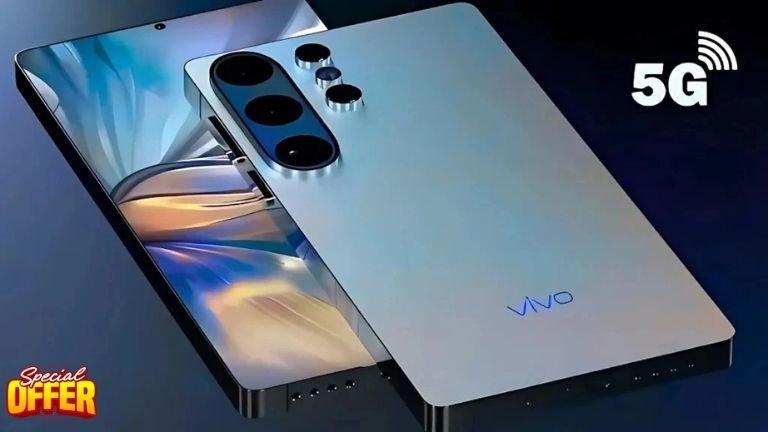
Vivo 5G New Premium Phone: The moment you pick up the Vivo Y31 Pro 5G you notice the size and the heft. At 204 grams (for Mocha Brown version) and with a thickness of about 8.09mm, the build feels solid though not ultra-light. The finish is in plastic (composite sheet back) rather than glass, but the quad-curved design and the styling in Dreamy White or Mocha Brown give it a more modern feel than many phones at this price.
What stands out is the display — a large 6.72-inch panel, vibrant enough and with a high 120 Hz refresh rate (which instantly makes scrolling and UI feel smoother). In bright daylight the brightness is decent (1050 nits peak) so outdoor usage isn’t a struggle.
So yes, in many ways it gives you the feeling of a “premium” phone (hence the phrase Vivo 5G Premium Phone while keeping the budget in check.
Display & Multimedia: Smooth, Bright, but Misses AMOLED
Vivo 5G New Premium Phone: For anyone who watches videos or scrolls social feeds a lot, the screen on the Vivo Y31 Pro 5G will impress more than many others in the sub-₹20,000 segment. The 120 Hz refresh rate adds fluidity to everything from swiping through Instagram carousels to reading long articles. Unlike 60 Hz screens where motion can feel choppy, here things feel more refined. The resolution is Full HD+, so text remains sharp.
However, there are trade-offs. The phone uses an LCD panel rather than AMOLED. That means the contrast and deep-black levels will be less impressive than flagship AMOLED phones. Some users noted this in reviews. Also, for HDR content, you might feel it lacks the punch of more premium displays, but for general use, it’s more than adequate.
On audio, the phone boasts stereo speakers and Hi-Res audio certification (24-bit/192kHz). Even though it’s not “flagship-tier loudest speaker ever,” for everyday video, music, and calls it delivers a competent experience.
In short: a strong display for its price class, especially with the smoothness factor. If you’re someone who prioritizes display quality above all, you may want an AMOLED alternative — but if you want overall balanced value, this display contributes well to the “Vivo 5G Premium Phone” feeling.
Performance: Can It Keep Up as a “Vivo 5G Premium Phone”?
Under the hood, the Y31 Pro 5G packs the MediaTek Dimensity 7300 chipset (built on a modern 4nm node) paired with 8 GB RAM (with “extended RAM” option) and UFS 3.1 storage. In real-life use, that means launching apps, switching between them, and gaming run smoothly. One review noted: “the phone handles popular games like BGMI and Call of Duty really well”.

Because it supports 5G across many bands (including n77/n78 used in India) the connectivity piece is future-ready — important in calling it a “Vivo 5G Premium Phone”. Vivo 5G Premium Phone The side-fingerprint sensor is responsive, and the UI (Funtouch OS 15) feels snappy. That said, this is mid-range performance — it won’t match ultra-expensive flagship chips in raw GPU horsepower or long-term heavy-rendering — but that’s okay given the price.
Heat-wise, there are no major complaints mentioned in early reviews, though sustained heavy gaming may raise temperatures somewhat (as is typical). As long as you don’t expect flagship-level thermal management, the performance is solid.
In summary: the phone is capable, well-rounded from a performance standpoint, and delivers what you’d expect from a “premium” 5G phone in this budget class.
Battery Life & Charging: One of the Big Wins
If I had to highlight the strongest chapter in this phone’s story, it’s battery life. With a 6,500 mAh capacity (widely given as 6500-mAh) and 44 W charging, the Y31 Pro 5G stands out. In day-to-day usage, users report the phone easily lasts a full day and even stretches into a second day if usage is moderate.
Charging from 0 to ~50% in about 40 minutes is good in this segment. Vivo 5G Premium Phone The modest but efficient chip + 4nm node help here. On a trip, you’re likely to wake up, use the phone for streaming, work, some gaming, and still have substantial battery by evening.
Of course, battery life will vary with usage pattern, but for those looking for longevity, this feature alone gives it a strong claim to being a “Vivo 5G Premium Phone”.
Cameras: Good Daylight Performance, Some Compromises
On paper, the camera setup is simple: 50 MP main sensor + 2 MP depth (instead of say ultra-wide) and 8 MP front. In daylight and good lighting conditions, the main sensor delivers sharp, well-colored photos. One reviewer said: “The camera system is another big plus…you’ll get amazing, sharp photos with bright colors.”
On the flip side, because the auxiliary camera is just a 2 MP depth, your flexibility is limited. In low light, the performance drops—noise creeps in, detail reduces, and you won’t get flagship-level night shots. Many mid-range phones have that trade-off. One user pointed out the display being LCD and not as premium as expected, which may reflect overall cost balancing.

The front camera is fine for selfies and video calls, but again not class-leading. Vivo 5G Premium Phone If you’re someone who prioritizes photography (especially ultra-wide shots or professional-grade low light), this may be a trade.
For most everyday users who snap social photos, share stories, the camera works well and complements the premium-feel of the device.
Design & Build: Durable, Stylish, Yet Some Trade-Offs
As mentioned earlier, the phone uses a plastic back (composite sheet) rather than glass. That means it may lack the “glass premium feel” of more expensive phones, but on the positive side it tends to be more durable (less shatter risk) and lighter in the pocket. The fact that it carries an IP64 rating (splash/dust resistance) and has “military-grade durability” marketing from Vivo also means it’s targeting users who need durability as part of the premium feel.
The colors (Dreamy White, Mocha Brown) are understated yet stylish, so it won’t feel cheap. Vivo 5G Premium Phone The curved back makes it comfortable to hold, even with a large display.
On the negative side: the weight is a bit higher than ultra-light models (204g is not feather-light). The plastic finish may not feel as “wow” as a glass/metal finish. If you like wireless charging, premium haptics, glass texture, you’ll notice the difference.
But given the price and overall balance, the design delivers a “premium” feel without breaking the bank—again supporting the “Vivo 5G Premium Phone” positioning.
Connectivity & Extra Features: 5G Ready, Some Missing Bits
The support for 5G is wide—covering major Indian bands including n78, n77 and more. So if you live in a city with 5G rollout, you’re future-proofed.
There are stereo speakers, Hi-Res audio certification, side-fingerprint sensor, IR blaster in some markets, and modern connectivity like Wi-Fi 5, Bluetooth 5.4. That’s good.

But there are a few omissions: no NFC in many units (so if you use contactless payments via NFC you may be restricted) and the display is LCD rather than AMOLED. Vivo 5G Premium Phone Some users flagged the display quality as not as good as expected in direct comparisons. If you rely heavily on NFC, this is something to check in your specific region/variant.
Still, for its price and especially with the “5G Premium Phone” mindset, the connectivity package is strong.
Price & Value: Is It Worth It?
With a launch price of around ₹18,619 for the 8GB+128GB variant in India and ~₹20,579 for the 256GB version, the Vivo 5G Premium Phone hits a very competitive bracket. Vivo 5G Premium Phone When you compare what it offers (large battery, 120Hz display, 5G, modern chipset) versus what rivals offer, you see strong value.
Of course, “premium” always has shades—this is not ultra-flagship pricing nor ultra-flagship features. Some compromises (LCD panel vs AMOLED, simpler camera setup) are real. But if you’re looking for a device that punches above its price and truly gives you many of the features that higher-priced phones deliver, you’ll feel you’re buying into a “Vivo 5G Premium Phone”.
It comes down to what your priorities are:
- If you prioritize battery life, smoothness (120Hz), future-proof connectivity (5G), and a modern look: Yes, it’s very strong.
- If you prioritize photography (especially ultra-wide, telephoto), ultra-premium materials (glass/metal), or ultra-bright/high-contrast AMOLED display: there are trade-offs.
Given all this, the value proposition is compelling.
Final Verdict: Should You Buy It?
If I were summarizing: Yes, the Vivo Y31 Pro 5G is a smart buy if you want a “Vivo 5G Premium Phone” experience without spending flagship-money. It ticks many of the right boxes — smooth display, strong battery, modern chip, future-ready connectivity. It’s well built for its class.
Where it falls short is expected: you won’t get ultra-premium materials, the camera won’t rival flagship beasts, and some premium features (NFC, AMOLED) are missing or limited. But for most users—day-to-day usage, streaming, scrolling social media, playing some games—it will serve beautifully.

If you buy it, just check variant (128 GB/256 GB), make sure you get the correct local bands, and if the display quality is a major priority for you consider viewing it in person. Vivo 5G Premium Phone But if you want balanced performance + strong battery + modern features under ₹20,000, this phone comes highly recommended.
FAQs
Q1: Is Vivo Y31 Pro 5G really a “premium” phone?
In the context of its price segment, yes—it brings many features of premium phones (120Hz display, large battery, 5G connectivity). It is best described as a “premium experience at mid-range price” rather than ultra-flagship luxury.
Q2: How long does the battery last in real use?
Users report more than a full day of heavy usage and even stretching into a second day if usage is moderate, thanks to the 6,500 mAh battery and efficient chipset.
Q3: Is the camera good for low light?
It delivers decent results in daylight and good lighting but falls short of flagship low-light performance. The lack of a high-end ultra-wide/telephoto and detailed night mode means you’ll see better in better light.
Q4: Does it support 5G and future-proof connectivity?
Yes — it supports multiple 5G bands relevant to India (including n77/n78) and has modern specs like 4nm chipset, mm-ready design etc.
Q5: What are the trade-offs I should know before buying?
Main trade-offs: LCD display instead of AMOLED, no built-in NFC in many variants, simpler camera setup (no ultra-wide/telephoto), plastic back instead of glass/metal. If those are deal-breakers for you, explore alternatives.